
Why Ron DeSantis Killed The Tool That Could Actually Fix American Democracy
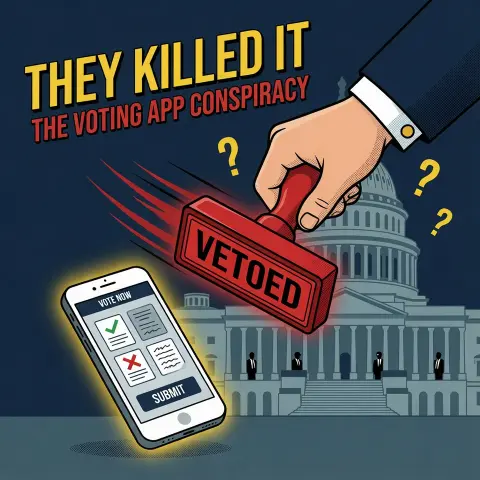
Imagine you pull out your phone... and you see every single bill your congressman is voting on this week.
You vote on it yourself. Your neighbors vote on it. Your whole district votes on it.
Then you watch - in real time - as your representative votes the exact opposite way you wanted.
No spin. No "my opponent took it out of context." Just the receipts.
Now imagine that tool actually exists.
And imagine a small-government Republican governor line-item vetoed it.
Welcome to the conversation I had with Ramon Perez on this week's episode of The Brian Nichols Show.
Strap in.
What Is The Digital Democracy Project?
The Digital Democracy Project is a nonprofit platform that uses verified mobile voting software to let registered voters tell their reps - bill by bill, in real time - exactly how they want them to vote.
Then it tracks what those legislators actually do on the floor... and grades them with a public scorecard.
Started in Florida in 2023. Went nationwide in 2025.
It's now live on federal bills plus state legislation in Virginia, Washington, Utah, Arizona, Michigan, and Massachusetts.
The goal? All 50 state capitals by 2027.
24,000 verified voters. 130,000 votes cast. 800+ bills tracked.
This isn't theoretical, folks. It's already happening.
Who Is Ramon Perez?
Ramon Perez is a 13-year military veteran with deployments to Iraq and Afghanistan, an AI and machine learning consultant for governments and Fortune 500 companies, and the Executive Director of the Digital Democracy Project.
So no... he's not some Silicon Valley utopian.
He's a guy who once voted in an overseas military election... and his ballot got back home so late that the candidate he voted for had already dropped out of the primary.
And here's the part that tells you everything about Ramon.
That didn't make him cynical. It made him go build a solution.
Why Did Ron DeSantis Line-Item Veto The Digital Democracy Project?
Ron DeSantis line-item vetoed the budget appropriation for the Digital Democracy Project because some Florida legislators didn't want their voting records held up against what their constituents actually asked them to do.
The scorecards exposed the gap between voter intent and legislator behavior.
And that gap? It's uncomfortable.
Let me say that again, slowly.
The bill had bipartisan support. A senior Republican from rural Ocala backed it. A progressive Democrat out of Orlando backed it. The conservative budget committee chairman from the panhandle moved it through.
It made it all the way to the governor's desk.
Then DeSantis killed it.
Why?
Because the scorecards work. And working scorecards mean accountability. And accountability means a whole lot of incumbent politicians lose their grip on a district they've been ignoring for 20 years.
That's the part nobody wants you to think about.
How Does Mobile Voting Actually Work?
The Digital Democracy Project uses Voatz, a mobile voting platform originally built so military service members overseas could cast absentee ballots from their phones.
Here's the verification stack:
- Voter file matching - the system confirms you're registered in your stated district
- Photo ID + selfie scan - your government ID gets matched against a live selfie to stop identity theft
- Encrypted vote tokens on a blockchain - votes go onto an immutable ledger maintained by independent auditing organizations
- AI-powered bill summarization - 1,000-page bills get translated into plain English so normal humans can actually understand what they're voting on
In other words... this isn't a SurveyMonkey poll.
This is verified, ID-checked, blockchain-secured voting infrastructure being used right now by deployed special forces operators.
And here's the thing: if it's secure enough for a submarine in the middle of the ocean... it's secure enough for your living room.
Why Don't Your Emails To Congress Matter Anymore?
Your emails to Congress don't matter anymore because lawmakers' offices use spam filters identical to your Gmail account.
Form-letter campaigns, astroturf advocacy, and now AI-generated outreach all get auto-filtered and ignored.
Staffers can't even verify whether the sender is a real constituent in the district.
And that's not paranoia. Ramon has sat in those offices in Tallahassee and DC and watched it happen.
Mass-email campaigns? Filtered.
AI-generated form letters? Filtered.
Your heartfelt three-paragraph plea about the glyphosate provisions buried inside that gobbledygook bill?
Probably filtered too.
The Digital Democracy Project flips this completely.
Because every voter is verified to a specific district up front, lawmakers get a clean number they can actually trust.
"1,247 of your verified constituents want you to vote NO on this bill."
Now THAT... is an unignorable signal.
The Shocking Stat: 94% Of Americans Live In Non-Competitive Congressional Districts
According to Ramon Perez, 94% of Americans live in a US House district that wasn't within a five-percentage-point margin in the 2024 election.
Only 6% of Americans live in a genuinely competitive district.
And on top of that? 80% of Americans live in a state where one party fully controls the governor's mansion, the legislature, AND the courts.
Let that sink in.
For 94% of you... the general election is decided before you ever step in the booth.
The primary is the actual election.
And the primary is dominated by the most ideologically extreme voters on both sides.
See, this is why your moderate, normal, common-sense neighbor feels politically homeless.
Because they ARE politically homeless.
The two-party system isn't a system anymore. It's just two parallel one-party states wearing different jerseys.
Is MAGA Actually Left Wing? Ramon's Hot Take
Ramon Perez argues that the MAGA movement is economically left wing and culturally right wing - and the evidence backs him up.
Tariffs are a left-wing economic tool. Senators Josh Hawley and Tom Cotton have pushed federal policies that mirror European social-democrat economics. Meanwhile, the blue-collar voters who used to anchor the Democratic Party have migrated straight to Trump.
So it's not that the working class became Republican.
It's that the Democratic Party abandoned them.
And Trump picked up a coalition of voters who never actually wanted libertarian economics in the first place... they wanted somebody who'd fight for them.
This reframes everything.
And it explains why third-party energy keeps building. Because most Americans aren't ideologues. They want common sense. They want their kids to do better than they did. They want a government that listens.
That's not a political philosophy.
That's just being human.
How To Get Involved With The Digital Democracy Project
To get involved, head to digitaldemocracyproject.org, download the app (or use the web version), complete the verification process, and start voting on active federal bills - plus state bills if you live in Florida, Virginia, Washington, Utah, Arizona, Michigan, or Massachusetts.
Want to do more?
- Volunteer your network - connect them with church groups, Chambers of Commerce, League of Women Voters chapters, civic clubs
- Volunteer your code - their dev team is 100% volunteer, and developers are always needed
- Volunteer your city - if you're on a city council, school board, or county legislature, reach out. They want to expand to the local level next
- Donate - they're a scrappy nonprofit doing this without a dime of taxpayer dollars
This is what grassroots actually looks like in 2026.
Not a yard sign. Not a bumper sticker.
A verified voting infrastructure that gives normal people the same direct-line access to legislators that lobbyists have had for fifty years.
The Bottom Line
Politics is downstream from culture. Andrew Breitbart was right about that one.
But culture? Culture is downstream from incentives.
And the incentive structure in American politics is broken... because the feedback loop between voters and legislators got severed somewhere around the rise of safe districts, super-PACs, and spam filters.
The Digital Democracy Project rebuilds that feedback loop.
That's why DeSantis killed it in Florida. That's why some legislators don't want it expanding.
And that's why - if you've been feeling politically homeless for the last decade - this might be the most important episode you listen to all year.
Listen To The Full Episode
🎙️ Listen on Apple Podcasts, Spotify, YouTube, Rumble, Amazon Music, or wherever you get your podcasts. New episodes of The Brian Nichols Show drop every Thursday at 9PM ET.
📱 Connect with Brian: @BNicholsLiberty on X, Facebook, and Instagram.
📧 Guest pitches, sponsor inquiries, or just want to say hi? brian@briannicholsshow.com
💊 Support the show by supporting our sponsors. Head to cardiomiracle.com/TBNS and use code TBNS for 15% off the supplement Brian uses every single day to power through 1,100+ episodes and counting.
Educated. Enlightened. Informed. And now... empowered.

Host
I'm Brian Nichols... and I spent years watching good ideas lose arguments they should've won.
Not because the ideas were wrong. Because nobody knew how to sell them. That's where I come in.
I come from the world of sales and marketing - helping businesses communicate better, close more deals, and actually solve real problems. Somewhere along the way, I realized those same skills translate directly to politics, policy, and culture. So that's what TBNS is.
Sales. Business. Politics. Health. Taught like a real human talks. No partisan cosplay. No debating obscure philosophy. Just practical conversations about what actually works - one episode at a time.
1,100+ episodes in. Still going.
Also: unapologetic Cowboys fan. We don't need to talk about it.


