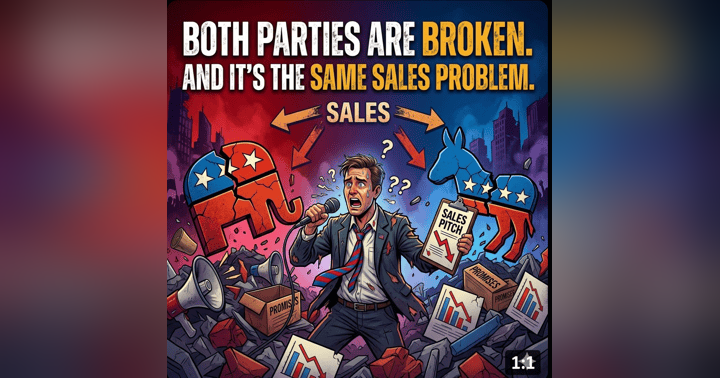
Creative Storytelling in Business: The Science of Communication That Resonates

The Presentation That Changed Nothing
Think back to when you were in school…
You're in class. Your teacher is standing at the board, scribbling formulas and equations, and you're furiously trying to keep up with your notes.
And then… she just stops writing. Turns around. And starts telling some random story.
What did you do?
You took a breath. You leaned back. You relaxed. You lowered your defenses.
And you started to listen.
Now hold that thought.
Because I watched something eerily similar play out in a corporate conference room not too long ago. A VP of Sales delivered one of the most technically flawless presentations I've ever seen. Sixty-two slides. Impeccable data. Market projections, competitive analyses, customer segmentation matrices… the works.
Every number was right. Every chart was sourced. Every conclusion was logically bulletproof.
And when he finished? The room was polite. People nodded. Someone said, "Great data." The CEO thanked him for his thoroughness.
Then nothing happened.
The budget wasn't approved. The strategy wasn't adopted. The initiative he'd spent three months building just… evaporated.
Dead on arrival. Despite being flawlessly constructed.
The next day, a product manager - someone with half the title and a quarter of the budget - walked into a different meeting and told a story.
She described a customer named James who'd called their support line four times in one week. Each time getting transferred to a different department. Each time having to re-explain his problem from scratch.
And she described the moment James said, quietly… "I just want someone to know who I am."
She didn't have sixty-two slides. She had one story.
And within two weeks? The company greenlit a complete overhaul of its customer support routing system.
Same organization. Same leadership team. Same fiscal constraints.
Radically different outcomes.
See, the VP had the data. The product manager had the story. And the story won - not because the data didn't matter, but because the data alone couldn't make anyone care.
That moment captures something I've been obsessing over for years… across more than a thousand podcast episodes and countless sales conversations. The gap between being right and being effective.
Between having the answer and getting people to act on it.
Between knowing your stuff and actually landing the message.
Here's the thing: is the goal to be right, or is the goal to be effective?
Because in communication… those are two very different things. And the bridge between them? Story.
That's what this pillar is about. Not storytelling as some "soft skill" or a nice-to-have on your LinkedIn profile. Storytelling as the hard skill that makes every other skill land.
The real, peer-reviewed, neuroscience-backed science of why narrative is the most powerful communication technology humans have ever developed… and how to deploy it systematically in business.
The framework at the center of this pillar is the Pain-Solution-Proof Sequence - a communication structure that matches how the human brain actually processes and accepts information. Around it, we've built supporting frameworks for clarity, engagement, memorability, and quality control.
Let's dig in.
Why Smart People Fail to Persuade
Here's something that'll frustrate every data-driven leader reading this…
Having the best information is not the same as having the most influence.
In fact? The people with the most knowledge are often the worst at communicating it.
There's actually a name for this. Chip and Dan Heath, in their book Made to Stick, call it the Curse of Knowledge - the phenomenon where once you know something deeply, you lose the ability to imagine what it's like not to know it.
You start speaking in abstractions, acronyms, and assumptions that make perfect sense inside your head… but land like a foreign language in everyone else's.
Sound familiar?
Think of it like this. If you've ever tried to explain to someone why they should care about a problem you've been wrestling with for months… you've felt the Curse of Knowledge in action.
You're so deep in the details that you've forgotten how you got there. You skip the context. You jump to conclusions. You present the answer without ever establishing the question.
And then you wonder why nobody's moved to action.
The Heaths identified six principles that make ideas "sticky" - Simple, Unexpected, Concrete, Credible, Emotional, and Stories.
Notice what didn't make the list?
"Comprehensive." "Thoroughly researched." "Supported by forty-seven footnotes."
Not because those things don't matter… but because they don't stick without the scaffolding of narrative.
The Information-Dumping Default
Most business communication operates on a fundamentally flawed assumption: that if you give people enough information, they'll reach the right conclusion.
I call this the "data dump" theory of persuasion.
And it fails almost every time.
Here's why: the human brain isn't designed to process raw information and convert it into action. It's designed to process meaning - patterns, stories, emotional signals - and then make decisions based on what those meanings imply.
When you dump data on someone, you're essentially handing them a pile of raw ingredients and hoping they'll cook a gourmet meal.
Most won't. Not because they're incapable… but because you've given them the ingredients when what they needed was the recipe.
Robert Cialdini, widely regarded as the foundational expert in the science of influence, has spent decades studying what actually moves people to say "yes." His research demonstrates that human decision-making relies heavily on mental shortcuts - heuristics that bypass the kind of deep analysis we assume people are doing when they review our slides.
Stories activate those shortcuts.
Data dumps don't.
And guess what… this is the exact same principle we talk about in sales all the time. You don't feature and benefit your prospect to death with a laundry list of specs. You tell them a story about someone just like them who had the same problem… and how it got solved.
Same science. Different context.
The Neuroscience Is Clear
This isn't just persuasion theory. Neuroscience has actually mapped what happens in the brain when we hear stories versus when we process raw information.
And the difference is dramatic.
Uri Hasson, a professor of psychology and neuroscience at Princeton, has conducted groundbreaking research on brain-to-brain coupling during storytelling. His lab uses fMRI to observe what happens in both the speaker's and listener's brains during narrative communication.
And here's the finding that changed how I think about communication…
When a story is effectively told, the listener's brain activity synchronizes with the speaker's. Their neural patterns align across multiple brain regions.
Think about that for a second.
When you tell a story well… you're not just conveying information. You're literally reshaping the listener's brain activity to mirror your own.
Hasson describes it as a form of neural coupling. And it's the mechanism through which shared understanding is created.
When this coupling happens, the listener doesn't just understand the story - they experience it. Their motor cortex, sensory cortex, and frontal cortex all light up as if they were living through the events themselves.
Now compare that to what happens when someone stares at a spreadsheet.
The language-processing areas activate. Maybe some analytical regions in the prefrontal cortex. But the deep, multi-region activation that creates meaning?
Absent.
This is the neurological basis for something every great salesperson, politician, and leader has known intuitively: people decide emotionally and justify logically.
The emotional response comes first. It's faster, deeper, and more powerful. The logical justification comes second - after the decision has already been made at a gut level.
Your sixty-two slides? They're the justification.
But without the emotional engagement to trigger the decision… the justification has nothing to justify.
The Pain-Solution-Proof Sequence: Core Framework
So if data dumps don't work… what does?
Let me introduce the communication framework that sits at the heart of this pillar: the Pain-Solution-Proof Sequence.
It's beautifully simple: structure all communication as What hurts → What fixes it → Evidence it works.
That's it. Three moves. Problem, solution, proof. In that order.
Always.
Why This Sequence Works
The Pain-Solution-Proof Sequence isn't just a handy template. It maps to how the human brain actually processes and accepts new information.
Step 1: Pain (What hurts). The brain is wired to pay attention to threats, problems, and unresolved tensions. Neuroscience tells us that when we encounter a problem - even someone else's problem described in a story - our brains release cortisol, the stress hormone that sharpens focus and attention.
Opening with pain creates the neurological conditions for engagement.
Think of it like a doctor's visit. You don't walk in and say, "I'd like some amoxicillin, please." You walk in and describe the pain: "My throat's been killing me for three days."
The pain establishes the need. Without it, the solution has no context.
Step 2: Solution (What fixes it). Once the brain has identified a problem, it actively seeks resolution. This is where dopamine enters the picture - the neurotransmitter associated with anticipation and reward.
When you present a solution to a problem someone already cares about… their brain experiences a small hit of satisfaction. Not because the problem is solved yet, but because the path to resolution has appeared.
And here's the thing: this is the moment most communicators skip straight to.
And it's why they fail.
Leading with the solution is like handing someone a key without showing them the locked door. They look at it and say, "Cool key, I guess?" and put it in a drawer.
Step 3: Proof (Evidence it works). The logical brain needs closure. After the emotional engagement of recognizing the problem and envisioning the solution, the analytical mind asks: "But does it actually work?"
This is where case studies, data, testimonials, and track records earn their place. Not as the opening act… as the closer.
Implementation Across Contexts
The Pain-Solution-Proof Sequence scales to virtually any communication context. Let me walk you through a few:
Sales pitch: "Your team is losing 4 hours per rep per week to manual data entry [pain]. Our platform automates 80% of that workflow [solution]. Three clients in your industry reduced their sales cycle by 22% within the first quarter [proof]."
Internal proposal: "We're getting a 15% support ticket escalation rate because customers can't self-diagnose basic issues [pain]. A guided troubleshooting tool in the customer portal could deflect the majority of those tickets [solution]. A pilot test in Q2 showed a 40% reduction in escalations with zero negative NPS impact [proof]."
Board presentation: "Market share in the mid-market segment has declined 8% year-over-year while our enterprise segment has grown [pain]. Reallocating 30% of our mid-market budget to a partner-led channel model addresses the reach gap without increasing headcount [solution]. Two competitors who made this shift saw mid-market recovery within 18 months [proof]."
Difficult conversation: "I've noticed the last three project deadlines were missed, and the team seems stressed and overwhelmed [pain]. I'd like to restructure how we scope sprint commitments to match our actual capacity instead of our aspirational capacity [solution]. When I did this with a previous team, burnout dropped and we actually shipped more because we stopped the constant context-switching of crisis mode [proof]."
You see where I'm going here, right?
Common Mistakes to Avoid
Starting with the solution. This is the #1 mistake. "Let me tell you about our amazing new product!" Nobody cares about your product until they care about the problem your product solves. Create the itch before offering the scratch.
I see this in sales ALL the time. Reps walk into a meeting and immediately start feature and benefiting the prospect to death. And then they wonder why the deal stalls.
Burying the pain. Some communicators mention the problem but then rush through it to get to the "positive part." Slow down. Let the pain breathe. The more vividly your audience feels the problem, the more urgently they'll want the solution.
Skipping the proof. Especially common in internal communication. You describe the problem, propose the solution, and then expect people to just trust your judgment. They might… but proof removes the need for trust and replaces it with confidence.
Why leave it to faith when you can provide evidence?
Reversing the proof and solution. I've seen presenters open with a case study - "Company X did this and got great results!" - and then try to back into the problem. It doesn't work. Without understanding the pain first, the proof has no emotional weight.
It's just a nice story about someone else's company.
The One-Sentence Test
If the Pain-Solution-Proof Sequence is the structure of great communication, the One-Sentence Test is the quality gate before you build that structure.
Here's the rule: if you can't explain the core idea in one sentence that a smart stranger would understand… you don't understand it well enough to communicate it effectively.
Not a run-on sentence. Not a sentence with three semicolons and a parenthetical. One clean, clear, declarative sentence that captures the essential idea.
This is harder than it sounds.
Way harder.
Because compression requires clarity. And clarity requires that you actually know what you're trying to say - not just the general territory, but the specific point.
The Discipline of Compression
When you're explaining, you're losing.
That phrase - one of my go-to principles for sales, politics, and communication - applies directly here. If your idea requires a fifteen-minute preamble before anyone understands what you're proposing… the idea isn't ready.
The One-Sentence Test forces you to identify the core - the single most important thing your audience needs to understand. Everything else is supporting material.
The core is the thesis. The supporting material is the evidence. If you can't separate the two, your communication will meander… and meandering is the death of persuasion.
This connects directly to what we call the Plain Language Test over in Radical Transparency - the idea that if a proposal requires jargon to sound reasonable, it probably isn't reasonable.
The One-Sentence Test and the Plain Language Test are siblings: both strip away the protective camouflage of complexity to reveal whether the underlying idea is actually solid.
Process: How to Distill
Here's a practical method for applying the One-Sentence Test:
- Write down everything you want to communicate. All of it. Don't edit. Just dump.
- Now ask: "If my audience remembers only one thing from this entire communication, what should it be?"
- Write that one thing as a single sentence.
- Read the sentence to someone who has no context. If they understand it and can explain it back to you… you've passed the test.
- Build the rest of your communication around that sentence. It's your north star.
If step 4 fails - if the person looks at you blankly or says "I think I get it, but…" - go back to step 3.
You haven't found the core yet.
The Tension-First Opening
Now we know the structure (Pain-Solution-Proof) and the clarity gate (One-Sentence Test). Let's talk about engagement - specifically, how to begin any communication in a way that makes people lean in rather than tune out.
The Tension-First Opening is exactly what it sounds like: begin with the problem, not the solution. Open with tension, not resolution. Create the question before offering the answer.
Why Tension Creates Attention
The neuroscience here is straightforward. The brain is an anticipation machine. It's constantly predicting what's going to happen next… and it pays the most attention when its predictions are violated or when it encounters unresolved questions.
This is why you can't put down a good mystery novel. It's not because the writing is beautiful (though it might be). It's because your brain has an open question - who did it? - and it won't rest until it gets an answer.
The technical term for this is the "information gap" - a concept explored extensively by George Loewenstein at Carnegie Mellon. When we perceive a gap between what we know and what we want to know… we experience a kind of mental itch that demands scratching.
The Tension-First Opening exploits this mechanism deliberately.
By starting with a problem, an unresolved tension, a troubling question, a scenario that doesn't sit right… you create an information gap that hooks your audience's attention.
And guess what… this is EXACTLY what we do in the Morning Sales Huddle every single day. We start with a scene. A story. A moment. We don't start with "Here are today's five sales tips."
We start with tension.
Opening Techniques
The story opening. Start with a specific, concrete story that illustrates the problem. Not "Organizations often struggle with customer retention." Instead: "Last Tuesday, a company I work with lost their third-largest client. Not because the product failed. Because nobody noticed the client was unhappy until they were already gone."
The provocative question. Ask something that challenges an assumption. Not "How can we improve our sales process?" Instead: "What if the reason your sales team is underperforming has nothing to do with your sales team?"
The counterintuitive fact. Lead with data that surprises. Not "Customer satisfaction is important." Instead: "Companies with the highest customer satisfaction scores are 40% more likely to lose market share in the next five years. Here's why."
The contrast opening. Juxtapose two scenarios. Not "We need to change our approach." Instead: "Two companies. Same market, same size, same product category. One grew 30% last year. The other filed for bankruptcy. The difference wasn't strategy. It was how they communicated with their customers."
Notice what none of these openings do.
They don't start with "In today's fast-paced business environment…"
They don't open with "Thank you all for being here today."
They don't begin with a definition or a history lesson.
They create tension immediately. The context comes later… once attention has been earned.
The Structure of Tension-Resolution
The Tension-First Opening isn't just about the first sentence. It establishes a pattern that should run through the entire communication:
Tension → Context → Insight → Resolution
Open with the tension (the problem, the question, the conflict). Provide enough context for the audience to understand why it matters. Deliver the insight (the "aha" that reframes the problem). Then offer the resolution (the solution, the framework, the call to action).
This mirrors how good storytelling works in any medium - film, novels, podcast interviews, even great sales conversations.
The audience is engaged because there's unresolved tension. The resolution is satisfying because the tension was real.
The Emotional Anchor Method
You've structured your message (Pain-Solution-Proof). You've clarified the core (One-Sentence Test). You've hooked attention (Tension-First Opening).
Now let's talk about making ideas stick.
Not just for the length of a presentation… but for weeks, months, and years after the conversation ends.
The Emotional Anchor Method is based on a simple insight: abstract ideas don't stick. Specific moments do.
Think about your own memory. You probably don't remember the specific tax rate from the economic briefing you sat through last quarter.
But you probably do remember the story your colleague told about the client who called on a Sunday morning in tears because a billing error had drained her business account.
The story created an emotional anchor - a vivid, specific moment that your brain encoded deeply because it triggered an emotional response.
The Science of Emotional Memory
Research on memory and emotion consistently demonstrates that emotionally charged events are remembered more accurately and for longer periods than neutral ones. The amygdala - the brain's emotional processing center - plays a key role in strengthening memory consolidation during emotional experiences.
This isn't just about "feelings." It's about neurobiology.
When you attach a concept to an emotional anchor - a story, a metaphor, a vivid image - you're recruiting your audience's amygdala as an ally in memory formation. The idea literally gets encoded more deeply because it's linked to an emotional state.
Techniques for Creating Emotional Anchors
Stories from the field. Nothing anchors a concept like a real story from a real person.
"Buyer empowerment" is abstract.
"The IT director who told me he felt like a hostage during the vendor demo because he wasn't allowed to ask questions" is concrete and emotionally charged.
The concept of buyer empowerment is now permanently attached to that story in the listener's mind.
I think back to my buddy Uncle Lou from my early telecom days. Every time a new sales rep got hired, Uncle Lou would stop by and hand them a travel-sized toothpaste and a pre-wrapped bar of soap.
At a telecom company.
Why? Because Uncle Lou wanted those new reps to understand something fundamental: we're not order takers. We're not selling commodities like toothpaste or soap that people grab off the shelf.
But there's a reason people pick the toothpaste they pick. It's the story.
That lesson stuck with me so hard that I still have one of those bars of soap displayed on my office mantle. That's an emotional anchor.
Analogies and metaphors. This is my go-to tool for explaining complex topics… and it's non-negotiable in everything we create.
Instead of: "Sales enablement technology can optimize your buyer engagement process."
Write: "Think of sales enablement like GPS for your buyers. You're not forcing them down a specific route - you're showing them the fastest way to get where they already want to go."
The first version activates language processing and… that's about it.
The second version activates spatial reasoning, personal memory (everyone has used GPS), and a gentle emotional resonance - the feeling of being guided versus controlled.
The metaphor does in one sentence what the jargon version couldn't do in a whole paragraph.
Vivid specifics. The difference between "our customer had a bad experience" and "our customer spent 47 minutes on hold, was transferred three times, and finally hung up during dinner with his kids" is the difference between forgettable and unforgettable.
Specifics create pictures. Pictures create emotions. Emotions create memories.
Building an Anchor Library
If you communicate regularly - presentations, pitches, team meetings, content creation - build a library of emotional anchors. These are the stories, analogies, and images you return to again and again because they reliably make abstract concepts concrete.
Here's my take: every framework, every product, every initiative should have at least one anchor story attached to it. When someone asks "What does [Framework X] actually mean?"… the answer should begin with a story, not a definition.
We're not anchoring for entertainment. We're anchoring for action.
The goal is for your audience to leave the room not just understanding the idea… but feeling it. Because feeling is what drives doing.
The Jargon Purge
Let's talk about the elephant in every corporate conference room.
Jargon.
The Jargon Purge is the quality control framework for this entire pillar, and it works like this: remove every industry term from your communication and see if the message still works.
If it doesn't? The jargon wasn't adding precision. It was hiding weakness.
Jargon as a Weakness Indicator
Here's something I've learned after years in the trenches of B2B sales and UCaaS: the more jargon someone uses, the less confident they usually are in the underlying idea.
Jargon is armor.
It makes simple ideas sound sophisticated. Mediocre ideas sound technical. And bad ideas sound like "industry best practices."
Now look - I'm not talking about technical terms that have genuine precision. "API," "EBITDA," "churn rate." Those serve a purpose when speaking to a technical audience.
I'm talking about the layer of corporate word-fog that turns "we should talk to our customers more" into "we need to leverage our omnichannel customer engagement ecosystem to drive synergistic touchpoints across the buyer journey."
Ugh.
The second version sounds impressive. It means exactly the same thing. And it has the additional problem of making the speaker sound like they've been taken hostage by a marketing automation platform.
George Orwell nailed this decades ago with his rules for clear writing - the most relevant being: "Never use a long word where a short one will do" and "If it is possible to cut a word out, always cut it out."
These rules aren't about dumbing down. They're about the discipline of genuine clarity.
The Translation Test
Here's the practical application: before any important communication, run the Jargon Purge. Take your message and translate it into language that someone outside your industry would understand.
If the translation is better - clearer, more vivid, more direct - use the translation. If the translation loses important nuance, add the nuance back in plain language.
Some common translations:
- "We need to optimize our go-to-market strategy" → "We need to get better at finding and winning customers"
- "This will enhance cross-functional collaboration" → "This will help teams work together instead of past each other"
- "We should leverage our core competencies" → "We should do more of what we're actually good at"
- "Our value proposition needs refinement" → "We need a clearer answer to why someone should buy from us"
Same ideas. Radically different clarity.
And clarity, as we explore in Radical Transparency, is a form of respect.
When you strip away the jargon, you're telling your audience: "I respect your time enough to communicate clearly."
When you leave the jargon in? You're telling them something else entirely: "I'm more interested in sounding smart than in being understood."
The Connection to Persuasion
Clear ideas survive translation. Weak ideas don't.
This is why the Jargon Purge is a quality control tool - not just a communication preference.
If your proposal falls apart when you remove the jargon… the proposal has a problem. And the jargon was covering for it.
This loops back to the Curse of Knowledge we discussed earlier. Experts default to jargon because it's the language of their internal thought process. The Jargon Purge forces them to translate that internal language into something external… something their audience can actually use.
Storytelling Across Business Contexts
Okay, let's get practical.
Here's where we take these frameworks and apply them in the contexts where they matter most.
Sales and Customer Communication
This is where storytelling lives or dies in real-time.
Every sales conversation is, at its core, a communication challenge: you understand the value of what you're selling. The buyer doesn't yet. Your job is to bridge that gap.
The Pain-Solution-Proof Sequence was essentially built for sales. The best salespeople I've worked with - and I've been in enterprise sales long enough to have seen a lot of them - instinctively follow this pattern.
They start by understanding the customer's pain (not pitching features). They present the solution in terms of the customer's world (not their own). And they provide proof that creates confidence (not just data that creates overwhelm).
Here's the thing that separates good sales communication from great…
Great salespeople use the customer's own language.
They listen for the specific words and phrases the buyer uses to describe their problems… and they mirror that language back in the solution presentation.
This is "meeting people where they're at on the issues they care about" in its purest form.
You don't control the demo. You let the buyer explore. You facilitate their understanding instead of force-feeding your narrative. You become the trusted advisor, not the pushy rep trying to hit quota.
Internal Leadership Communication
If anything, storytelling is more important in internal communication than external.
Why? Because your team hears from you constantly. They've been trained to tune out corporate-speak, all-hands announcements, and "exciting new initiative" emails.
Story cuts through that noise.
When you need to communicate a strategic shift, start with the why - told as a story.
Not "market conditions require a pivot."
Instead: "I got a call from our largest customer last month, and what they said changed how I think about our next twelve months. Let me share what they told me."
When you need to deliver difficult news, the Compassionate No Framework from Empathetic Realism provides the structure… and story provides the warmth. You can deliver hard truths when they're wrapped in genuine narrative that shows you understand the human impact.
Investor and Board Presentations
This is where most leaders default to data dumps… and it's where story provides the biggest competitive advantage.
Board members and investors sit through dozens of presentations. The ones that stick - the ones that get funded, approved, and championed - are the ones that tell a compelling story supported by data. Not the other way around.
The Pain-Solution-Proof Sequence, applied to a board presentation:
Pain: "Our customer acquisition cost has increased 40% while conversion rates have dropped. At current trajectory, we become unprofitable in this segment within 18 months."
Solution: "We've identified that the root cause is friction in the trial-to-paid conversion flow. A redesigned onboarding experience - focused on the three moments where most users drop off - can reverse this trend."
Proof: "A controlled test with 500 users showed a 28% improvement in conversion when we simplified the onboarding flow. Two SaaS companies of similar scale saw comparable results when they made this shift."
Clean. Clear. Compelling.
And notice: the data is all there. It's just sequenced in a way that makes the brain want to process it.
Written Communication and Content Marketing
Everything I've described applies to the written word too… maybe even more so. Because the reader can leave at any time.
There's no social pressure to sit politely through your blog post the way there is in a conference room.
Written content needs to earn attention with every paragraph. The Tension-First Opening hooks the reader. The Pain-Solution-Proof Sequence gives the piece a narrative backbone. The Emotional Anchor Method creates moments the reader remembers after they close the tab. And the Jargon Purge ensures the writing is clear enough to be understood on a single read.
If your content reads like a corporate white paper… you've already lost.
If it reads like a smart friend explaining something important over coffee… you're in the zone.
Integration: The Complete Storytelling System
Let me show you how all five frameworks in this pillar connect and reinforce each other. Because like the other pillars… these aren't isolated tools. They're a system.
The One-Sentence Test ensures you know what you're trying to say. It's the foundation - without it, everything else is built on sand.
The Tension-First Opening creates engagement. It hooks your audience by opening with a problem, a question, or a conflict that their brain needs to resolve.
The Pain-Solution-Proof Sequence provides the structure. It organizes your communication in the order that matches how human brains actually process and accept information.
The Emotional Anchor Method creates memorability. It attaches your ideas to concrete stories, metaphors, and images that your audience will remember long after the facts have faded.
The Jargon Purge ensures authenticity. It strips away the corporate camouflage to reveal whether your ideas are genuinely solid or just dressed up in expensive words.
Together, they form a complete communication system that can be applied to any context… from a five-minute conversation to a keynote speech to a fifty-page proposal.
Practice Protocols for Improvement
Storytelling, like any skill, improves with deliberate practice. Here are some ways to build the muscle:
The story bank. Start collecting stories from your professional life - customer interactions, team challenges, personal failures, moments of insight. Write them down. Keep them in a document you can reference.
The best communicators aren't making up stories on the fly… they're drawing from a curated library of experiences that they can deploy at the right moment.
I do this constantly with the podcast. After 1,000+ episodes, I've got a mental Rolodex of stories that I can pull from for virtually any sales or communication situation. That didn't happen overnight. I built it.
The elevator test. For any major communication, practice delivering the core message in under 60 seconds. If you can't do it… you haven't found the core yet. This is the One-Sentence Test in action.
The outsider review. Before any high-stakes communication, show it to someone outside your field. If they understand it, you've passed the Jargon Purge. If they don't… you've got work to do.
The "so what" drill. After every key point in your communication, imagine your audience asking "So what?" If you can't answer that question with a direct statement of why this matters to them… the point isn't ready.
Connection to Other Pillars
Storytelling doesn't exist in isolation. It's the delivery mechanism for every other pillar:
Resilient Forward Motion needs storytelling to create urgency. The 72-Hour Rule is more compelling when illustrated by a story of what happened when a decision sat too long.
Radical Transparency needs storytelling to make honesty feel human, not brutal. The Pre-Disappointment Conversation is a form of narrative - proactively telling the story of what could go wrong.
Support-Centric Leadership needs storytelling to make systemic thinking tangible. The Bus Factor Audit becomes real when you tell the story of the organization that collapsed when one person left.
Empathetic Realism needs storytelling to deliver hard truths with warmth. The Compassionate No is a narrative structure - acknowledging, declining, explaining, offering.
The Trust Velocity Formula - the cross-pillar framework that combines Radical Transparency, Empathetic Realism, and Service-Oriented Success - is essentially a story formula: be honest, be kind, and be useful.
That's a narrative arc that builds trust at compounding rates.
The Storyteller's Advantage
Here's what I want you to take away from this…
Storytelling isn't a nice-to-have. It's not a "soft skill" that you develop after mastering the "real" skills of analysis, strategy, and execution.
Storytelling is the skill that makes all those other skills matter.
You can have the best product in the market. If you can't tell the story of why it matters… you'll lose to someone with a worse product and a better narrative.
You can have the right strategy. If you can't communicate it in a way that makes people care… it'll die in committee.
You can have the answer to your customer's problem. If you can't connect that answer to their pain, in their language, through their experience, on their terms… they'll walk right past you to the competitor who can.
That VP with the sixty-two slides? He wasn't wrong. He was just ineffective.
And in business… ineffective is indistinguishable from wrong.
The product manager with the one story? She wasn't more senior, more experienced, or more analytical. She was more human.
She understood that communication isn't about the information you deliver… it's about the meaning you create.
And meaning lives in narrative.
Meet people where they're at on the issues they care about.
That's the brand manifesto. And the way you meet them there… is through story.
So here's your challenge: think about the most important thing you need to communicate this week. A proposal. A difficult conversation. A pitch. A team update. Whatever it is.
Now run it through the system.
Can you pass the One-Sentence Test? Can you open with tension? Can you structure it as Pain-Solution-Proof? Can you anchor it with a story or metaphor? Can you survive the Jargon Purge?
If yes… go deliver it. The brain science says you'll land.
If not… you've got the frameworks to fix it.
And the 72-hour clock just started.

Host
I’m Brian Nichols - host of The Brian Nichols Show, sales and messaging strategist, liberty advocate, husband, dad, and unapologetic Cowboys fan (yes, still).
I come from the world of sales and marketing, and I’ve spent years helping businesses figure out how to communicate better, close more deals, and actually solve real problems. Along the way, I realized that the liberty movement was failing - not because the ideas were wrong, but because we didn’t know how to sell them.
That’s where I come in.
My show takes a no-BS approach to making liberty work in the real world. It’s not about debating obscure philosophy or pretending we live in some anarcho-utopia. It’s about helping people take ownership of their lives and communities - one conversation at a time.
Here’s how I break it down each week:
1. Health & Wellness: Because liberty starts with personal responsibility - and if you’re not healthy, you’re not free.
2. Politics, Culture & Policy: We dig into the headlines and talk real solutions, not partisan cosplay.
3. Business, Sales & Entrepreneurship: Whether you’re selling a product, a service, or an idea - you’re in sales. I’ll help you do it better.
Off the mic, I lead channel operations at a UCaaS company, helping tech advisors crush it in the contact center space. I also wrote The CX Compass, a playbook for anyone trying to navigate customer experience without losing their mind (or their margins).
Most importantly, I’m a husband to an amazing wife, a dad to a beautiful little girl, and a guy…Read More

Continuous Learning: Building Personal and Organizational Adaptability