
We Cut Emissions 20% Without A Carbon Tax. So Why Is This Republican Still Pitching One?
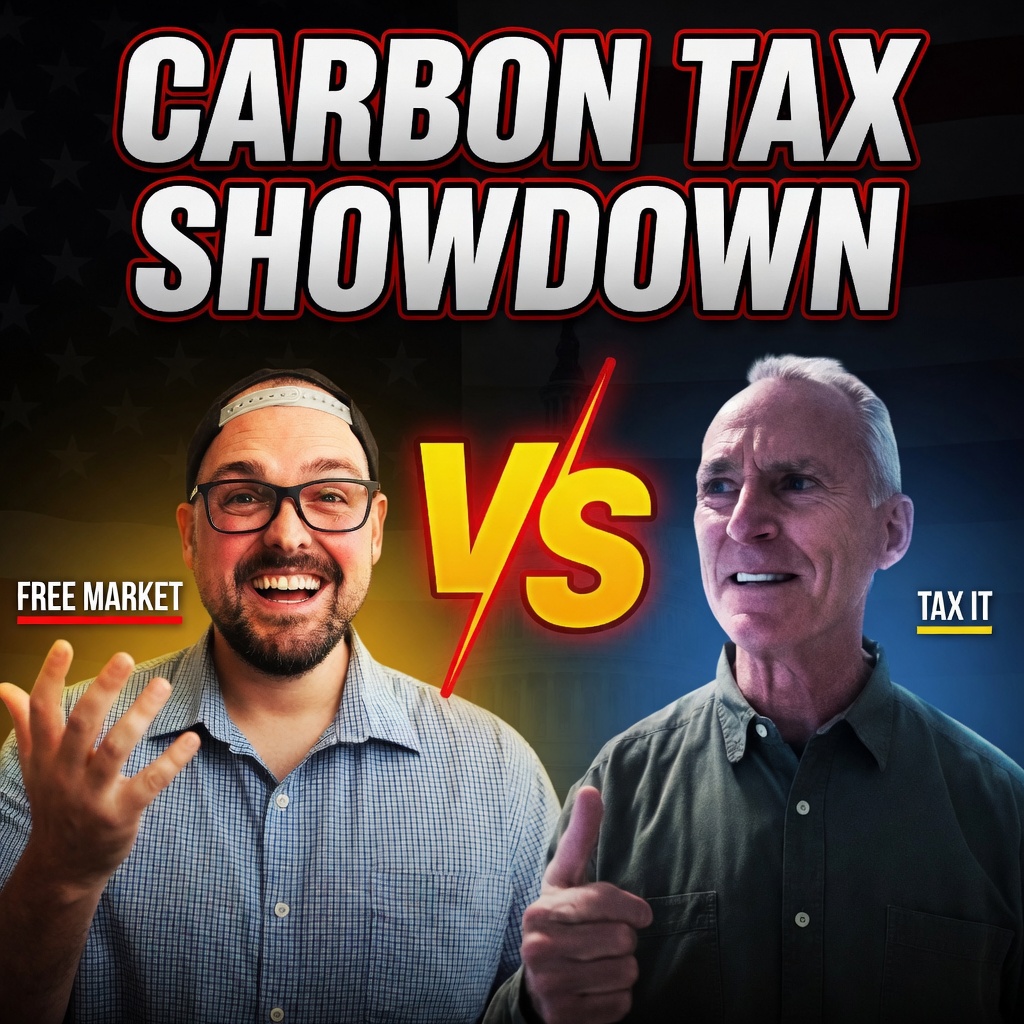
A Republican congressman came onto my show this week to sell me a carbon tax.
Not a Democrat. Not a progressive. A six-term Republican from one of the reddest districts in South Carolina... pitching me a federal tax on the energy that powers civilization.
And he had the receipts to make it sound reasonable. Milton Friedman quotes. CBO modeling. A JFK Profile in Courage Award sitting on his mantle.
So I let him cook. And then I asked the questions nobody else is asking him.
Here's what happened... and why his pitch falls apart the second you look at the data.
Who Is Bob Inglis?
Bob Inglis represented South Carolina's 4th Congressional District in the U.S. House of Representatives from 1993 to 1999... and again from 2005 to 2011. He's a committed Christian, an actual conservative on paper (93% American Conservative Union rating, 100% Christian Coalition, A with the NRA), and the founder of republicEn.org... a nonprofit advocating for a carbon tax as the "conservative" solution to climate change.
He also lost his 2010 Republican primary to Trey Gowdy by a margin of 71 to 29.
The reason? He introduced the Raise Wages Cut Carbon Act in 2009. His constituents disagreed... loudly.
Fourteen years later, he's still pitching the same idea. And in 2015 he won the JFK Profile in Courage Award for the same position that cost him his seat.
You have to respect the consistency. The question is whether the idea actually works.
What Is The "Conservative Case" For A Carbon Tax?
Inglis's pitch has three moving parts. Pay attention because he stacks them fast...
One. A federal tax on carbon emissions at the source. Specifically the roughly 2,000 companies in America that mine coal or pipe fossil fuels.
Two. Pair that tax with an equal cut to payroll taxes. He calls this "revenue-neutral." Congressional Budget Office modeling says the bottom 70% of earners come out ahead.
Three. Apply the same tax at the border on imports from countries without an equivalent carbon price. He calls this a "border adjustment mechanism" and says it forces China and other major emitters to either pay us... or adopt their own carbon tax.
The pitch sounds reasonable on first hearing. Milton Friedman did argue on the Phil Donahue Show in the 1980s that taxing pollution was better than regulating it. Inglis references this constantly.
But here's where it breaks down.
Does A Carbon Tax Actually Stay Revenue-Neutral?
Short answer? No federal tax in American history has stayed revenue-neutral. Not one.
I asked Bob to name a single example. He couldn't.
What he said instead was "yeah, you're right that we've had ebb and flow of taxes." That's the guest conceding the structural critique on camera.
Look at the receipts...
The federal income tax started in 1913 at 7% on millionaires only. Today the top rate is 37%... and it touches the working class.
Social Security started capped at $3,000 of wages. Today the cap is over $176,000... and Congress is having open conversations about removing it entirely.
The Alternative Minimum Tax was created in 1969 to catch 155 wealthy households dodging taxes. Today it touches millions of middle-class Americans.
The pattern is the pattern. "Temporary" becomes permanent. "Revenue-neutral" becomes a moving target. The mechanism gets built... and then future Congresses turn the dial.
And here's the kicker. Payroll taxes fund Social Security and Medicare. Two programs already racing toward insolvency. The idea that a future Congress will permanently slash payroll tax revenue... while preserving the carbon tax half of the equation... isn't a plan. It's a fantasy.
Has A Carbon Tax Worked Anywhere It's Been Tried?
This is the question Bob dodged on the show. So let's answer it ourselves.
Australia passed a carbon tax in 2012. They repealed it in 2014.
France tried implementing one in 2018. It triggered the Yellow Vest protests... massive, sustained, working-class riots in the streets of Paris.
Canada has one right now. It's the single most contentious political issue in the country... and the federal Conservative Party has been running on repealing it.
Washington State voters rejected a carbon tax twice. In 2016 and again in 2018. And that's a state that voted for Hillary Clinton by 16 points.
The empirical record isn't ambiguous. Voters reject this policy when given a direct choice. Working-class people revolt against it when it's imposed. Governments that pass it get punished.
When I laid this out for Bob, he made a joke about calling King Charles III back to rule us. Funny line. Not an answer.
How Did The US Cut Emissions 20% Without A Carbon Tax?
Here's the part the carbon tax crowd really hates...
The United States has cut greenhouse gas emissions by approximately 20% over the last 15 years. Without a carbon tax. Without a federal mandate. Without bureaucrats setting prices.
How?
Natural gas replacing coal. Mostly from hydraulic fracturing... fracking. The fracking revolution cratered the cost of natural gas. Power companies switched from coal to natural gas because it was cheaper. Emissions dropped as a byproduct.
That's the free market solving the problem the carbon tax was designed to solve. And it happened FASTER than most carbon tax modeling predicted.
When I pointed this out, Bob's response was that George Mitchell - the guy who perfected fracking - used some DARPA-funded research. As if a government grant 40 years ago means the government deserves credit for a private sector revolution.
It doesn't. It really doesn't.
So What's The Actual Free-Market Climate Answer?
If you actually want emissions to drop without crashing the economy... here's what the data says works.
Unleash nuclear. America hasn't built a nuclear plant in decades because of regulatory strangulation. Nuclear is zero-emission baseload power. The conservative answer isn't to tax carbon... it's to deregulate the cleanest scalable energy source we have.
End ALL energy subsidies. Fossil fuels. Wind. Solar. EVs. All of it. Let the actual price signal flow. Inglis says he agrees with this in principle. Then he asks for a tax on top of it.
Permit reform. Building anything in America - transmission lines, pipelines, geothermal, nuclear, even solar farms - takes years of permitting hell. Cut the red tape. Build things.
Private innovation, vested interest. Elon Musk didn't build Tesla because of a carbon tax. He built it because he saw a market opportunity. Domino's didn't pave the potholes around their stores because of a federal mandate. They did it because their drivers' cars kept breaking and it hurt their bottom line. That's vested interest doing what regulation can't.
These aren't theoretical. They're the actual mechanism by which America cut emissions 20% without ever passing Bob Inglis's bill.
The Bottom Line
I respect Bob Inglis. He took a real political hit for his position. He's been pitching it consistently for over a decade. That takes spine.
But respect for the man doesn't mean accepting the argument.
The "conservative carbon tax" isn't conservative. It's a new federal tax mechanism, a new enforcement bureaucracy, a new layer of trade tariffs, and a "revenue-neutral" promise that history says won't hold.
And it's a solution in search of a problem the free market is already solving.
We cut emissions 20%. Without his tax. Without Washington picking winners. Without Yellow Vest riots.
The path forward isn't another federal lever. It's more freedom, less regulation, and trust that markets - and Americans - will figure it out.
They already are.

Host
I'm Brian Nichols... and I spent years watching the liberty movement lose arguments it should've won.
Not because the ideas were wrong. Because nobody knew how to sell them. That's where I come in.
I come from the world of sales and marketing - helping businesses communicate better, close more deals, and actually solve real problems. Somewhere along the way, I realized those same skills translate directly to politics, policy, and culture. So that's what TBNS is.
Sales. Business. Politics. Health. Taught like a real human talks. No partisan cosplay. No debating obscure philosophy. Just practical conversations about what actually works - one episode at a time.
1,100+ episodes in. Still going.
Also: unapologetic Cowboys fan. We don't need to talk about it.


