
Why Is My Electric Bill So High in 2026? (Spoiler: It's Not AI or Data Centers)
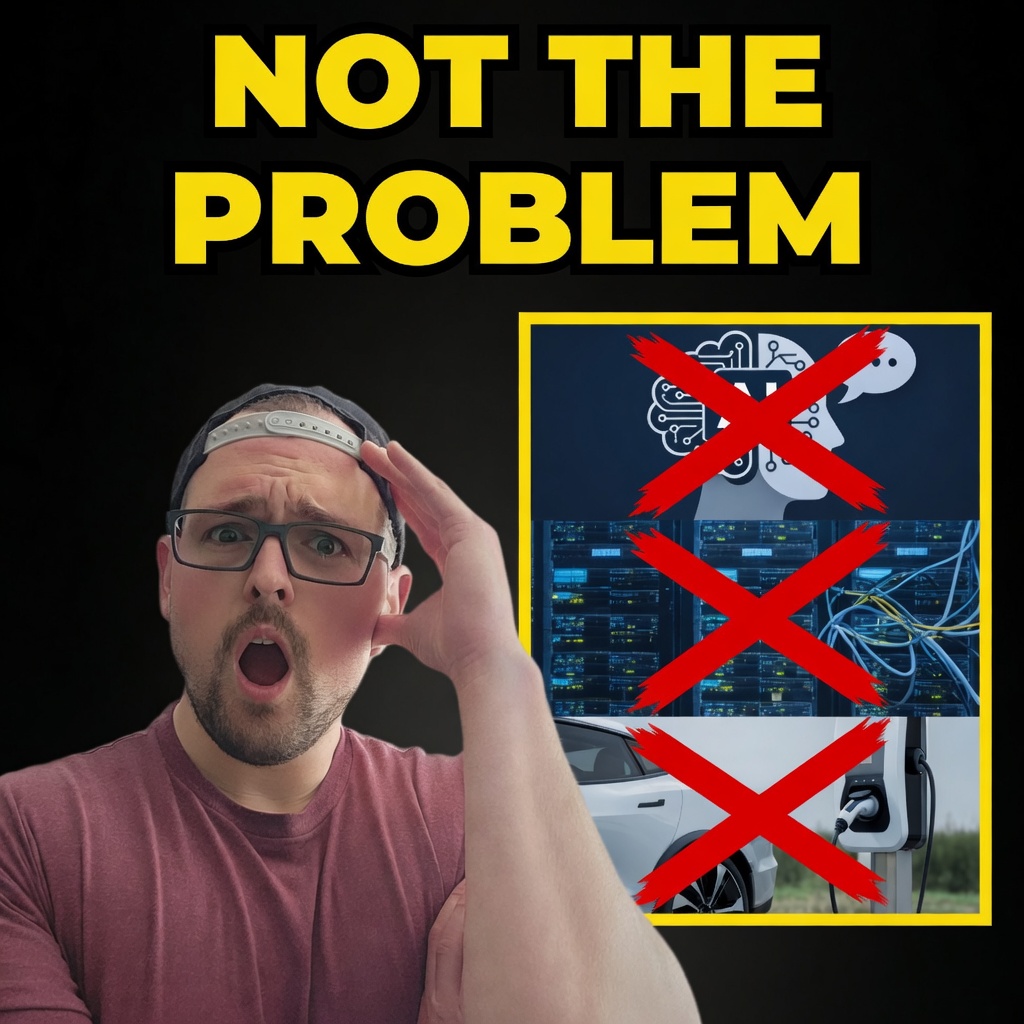
You've looked at your electric bill lately. It's bad. And every headline out there has a different answer for why...
AI is sucking up the grid. Data centers are draining capacity. Electric vehicles are overloading transformers. Inflation is doing what inflation does. Pick your villain.
But what if I told you that the real reason your bill keeps climbing has almost nothing to do with any of that?
That's exactly what energy analyst Isaac Orr - co-founder of Always On Energy Research and one half of the Energy Bad Boys Substack - laid out on a recent episode of The Brian Nichols Show. And once you hear the actual explanation... you can't unsee it.
🎥 Watch the full conversation: https://www.youtube.com/watch?v=iwbCd_FWOOw
The Short Answer: Why Your Electric Bill Is Really Going Up
Your electricity rates aren't exploding because of AI. They aren't exploding because of data centers. They aren't exploding because of EVs.
They're exploding because of three things working together...
- Monopoly utility companies that have no competition and are guaranteed a profit by law.
- A regulatory formula that lets them charge you for everything they spend - plus roughly 10% on top.
- State policy decisions made 7 to 10 years ago to shut down reliable, low-cost coal plants and replace them with wind, solar, batteries, and natural gas.
That's it. That's the whole scam.
Everything else - the data centers, the AI hype, the EV chargers - those are downstream factors at best. Some of them actually lower your bill in the right conditions. We'll get to that.
But first, let's talk about why the obvious villains aren't actually the villains.
Why Everyone Blames AI, Data Centers, and EVs (And Why They're Mostly Wrong)
Look, the narrative makes intuitive sense. Big shiny new thing shows up. Your bill goes up. Big shiny new thing must be the cause.
It's the classic "where there's smoke, there's fire" assumption.
But here's the inconvenient truth Isaac dropped on the show... most of those data centers being announced? They haven't been built yet. They're in planning. Some are in permitting. A few are breaking ground. The big "AI infrastructure boom" headlines are about projected demand, not actual current demand drawing from your local grid.
So if data centers aren't even online yet... how could they be the reason your bill jumped 15-30% over the last three years?
They aren't. The rate hike you're seeing right now is the result of capital decisions your state utility commission approved years ago. And we're going to break that down piece by piece.
The Cost-of-Service Formula: The Monopoly Utility Scam Hiding in Plain Sight
Here's the part of the story that almost nobody outside the energy policy world understands. And it's the part that matters most.
Your electric utility - whether it's NIPSCO in Indiana, Xcel Energy in Minnesota, Duke Energy in the Carolinas, or whoever serves your zip code - is a regulated monopoly. You don't get to shop around. You can't switch to a competitor. They are the only game in town.
So how do they decide what to charge you? Through something called the cost-of-service formula.
The way it works is brutally simple, and it's the exact opposite of how every other business in America runs...
A regular business has competition. If they overspend, they lose customers and go bankrupt. That's the discipline of the market.
A monopoly utility doesn't have that. There's no competing electric company down the block you can switch to. So the government - usually a state public utility commission - sets the price.
And here's where it gets ugly.
The utility is allowed to charge you back for everything it spends. Plus a guaranteed return on equity of roughly 10% on top.
Want to build a new wind farm? The utility builds it... and then charges you enough to cover the cost plus 10% profit.
Want to build natural gas backup? Same deal. Cost plus 10%.
Want to upgrade transmission lines? You pay. They profit.
You see where I'm going here, right?
The financial incentive isn't to keep your bill low. The financial incentive is to spend more money so they can make more profit. The more capital they sink into the grid, the bigger their guaranteed return.
That's not a free market. That's a permission slip to print money.
Why Indiana Electric Rates Are Rising Twice as Fast as the National Average
Now let's get specific.
Isaac and the Always On Energy Research team have been tracking electricity prices state by state. And the data is brutal.
Indiana electric rates have been rising almost twice as fast as the national average.
Why Indiana? Because the utilities in Indiana have been doing exactly what the cost-of-service formula incentivizes them to do...
They're shutting down their reliable, fully-depreciated coal plants. Those coal plants no longer earn the utility a profit because they've already been paid off. So from the utility's perspective, they're dead weight.
What's replacing them? Wind farms. Solar facilities. Battery storage. New natural gas plants.
All of which the utility gets to build. And recover the cost of. Plus 10% on top.
Meanwhile, the old coal plant that was producing the cheapest electricity on the system gets retired. Even though it still works. Even though it's reliable. Even though it doesn't care if it's cloudy or the wind isn't blowing.
This is happening across the Midwest, the Mid-Atlantic, and the Northeast. Indiana is just one of the most aggressive examples. And the people paying the price are... well, you.
Sound familiar?
Blue States, High Rates: When Your Politics Become Your Power Bill
Here's the part that's going to make some people uncomfortable. Good.
Always On Energy Research published a report titled "Blue States, High Rates". The thesis is exactly what the title sounds like.
When you map the states with the highest electricity prices in America, the resulting map looks almost identical to the electoral map of the United States.
California. New York. Massachusetts. New Jersey. Maryland. Connecticut. Rhode Island. Vermont. Hawaii.
These are the most expensive states for residential electricity. They are also the states with the most aggressive renewable portfolio standards, the most coal plant retirements, the most net-metering mandates, and the most participation in carbon trading programs like the Regional Greenhouse Gas Initiative (RGGI).
This is not a coincidence. It is a direct policy consequence.
And here's the kicker that Isaac dropped on the show...
"If blue state policies make electricity so affordable, why are they repealing them? Why are they walking back from them?"
That's the question nobody on the activist side wants to answer. Because the data is staring them in the face.
The Data Center Question: Who Pays for the Build-Out?
OK, so if data centers aren't currently exploding your bill... what happens when they actually do come online at scale?
This is where the policy decisions matter more than the technology.
Isaac broke down two very different approaches happening right now...
The Smart Way (North Dakota, Texas, Pennsylvania)
In North Dakota, the state's Economic Development Commission tells data center developers something refreshingly simple: "If you're going to build a power plant for your data center, build one bigger than you need. Sell the excess back to the grid."
The result? More electricity supply. Which - thanks to that same cost-of-service formula working in reverse - actually drives down rates for everyone else when there's slack capacity.
In Texas, big data center developers are going "behind the meter" entirely. They build their own dedicated power plants on private land, hooked into the ERCOT grid only minimally or not at all. The data center pays for its own infrastructure. Residential ratepayers don't subsidize a dime.
That's the smart way. And it's working.
The Dumb Way (New Jersey, Maryland, Pennsylvania, the Northeast)
Then there's the disaster zone.
The PJM Interconnection region - Pennsylvania, New Jersey, Maryland, parts of Virginia - has spent the last decade shutting down reliable coal and nuclear plants. Now data centers are arriving in droves looking for the cheap, reliable power that... no longer exists.
The result? Wholesale electricity prices in that region have spiked dramatically. And residential ratepayers are footing the bill for the grid upgrades needed to serve the new commercial load.
You shut down what worked. Now you can't afford to keep the lights on.
It's not complicated. It's just expensive.
The $1.4 Trillion Bombshell Coming for Your Wallet
Let me give you one number that should stop you cold.
$1.4 trillion.
That's the projected spending on new power plant infrastructure in the United States over the next five years.
Now, here's where the cost-of-service formula kicks you in the teeth one more time. Most of that capital expense will get passed through to ratepayers. Depending on the state, residential and small commercial customers typically end up paying for roughly 20% of new grid infrastructure costs.
Twenty percent of $1.4 trillion is... let me check my math here... $280 billion.
That's the residential ratepayer share of the next five years of grid build-out. Divided across roughly 130 million American households. You can do the per-household math yourself.
It's a lot.
The $4,000 Bombshell New York Doesn't Want You to See
If you want to see exactly where this ends up, look at New York.
New York passed a sweeping climate law in 2019 - the Climate Leadership and Community Protection Act - mandating aggressive emissions reductions, electrification of heating, retirement of natural gas infrastructure, and a build-out of wind and solar.
In late 2025, NYSERDA - the New York State Energy Research and Development Authority - released a report that quietly admitted the actual cost of implementing this law.
It would increase the cost on a per-household basis by approximately $4,000 per year.
Per household. Per year. Every year. Forever.
That's not a tax. That's not a one-time hit. That's a recurring $4,000 annual cost layered onto every household in the state of New York if the law is fully implemented as written.
And Governor Kathy Hochul, who once championed the law? She's suddenly singing a different tune. Talking about "re-evaluating." Talking about "revisiting" the timeline.
Why now? Because the midterms are coming. Because she can read a poll. Because she knows that $4,000 a household lands very differently when it's written into law versus when it's a campaign talking point.
Same story playing out in Massachusetts with their heat pump mandates. Same story in New Jersey. Same story in Connecticut.
The ideology is finally colliding with the physics of how the grid actually works. And the politicians are scrambling.
Winter Storm Reality Check: When Renewables Failed
One more thing worth flagging.
During a recent major winter storm, the renewable portion of the grid - wind and solar - dramatically underperformed. As Isaac put it on the show: "Wind and solar did not do so hot."
Meanwhile? The coal fleet, the natural gas fleet, and the nuclear fleet kept producing.
This is the part of the conversation that gets buried in the trade press but matters enormously for policy. When the chips are down - extreme cold, extreme heat, prolonged cloud cover, low wind - the technologies that keep your house warm and your hospital running are the ones a lot of states are aggressively retiring.
You don't have to be anti-renewable to think this is insane. You just have to know how a grid actually works.
What You Can Actually Do About It
So... what's the play? You're not the regulator. You're not the utility CEO. You can't single-handedly reopen a coal plant.
Here's what you can do.
1. Know who your state utility commission is. Almost nobody does. These are the unelected (or rarely-elected) bureaucrats approving every rate hike, every plant retirement, every new transmission project. They hold public hearings. You can submit comments. Almost nobody shows up. The ones who do show up tend to be activists pushing for more aggressive retirements of reliable generation.
You can change that math by showing up.
2. Pay attention to integrated resource plans. When your utility files an IRP - basically their long-term plan for how they'll meet electricity demand - that's the document that determines your bill for the next 15-20 years. Activist groups read these documents. You should too.
3. Vote at the state level like it matters. Because it does. The Federal Power Act delegated most electricity regulation to the states back in the early 1900s. That means your governor, your state legislature, and your state regulators determine what you pay for power. Not Congress. Not the president. Your state.
4. Demand reliability metrics, not just emissions metrics. Most state energy mandates are written entirely around carbon reduction. They say nothing about reliability or affordability. That's a feature, not a bug, in the way they're designed. Push your representatives to require all three in any energy policy: clean, reliable, and affordable.
5. Subscribe to people who actually know what they're talking about. Energy Bad Boys is one. Always On Energy Research is another. There are more. The activists are loud. The serious analysts are quiet. Amplify the analysts.
The Bottom Line
Your electric bill isn't exploding because of AI.
It isn't exploding because of data centers.
It isn't exploding because of EVs.
It's exploding because a regulated monopoly utility, working hand-in-hand with a state regulator, was authorized years ago to retire your cheapest, most reliable power generation... and replace it with a more expensive mix that earns them a guaranteed return on every dollar they spend.
The policy decisions that landed on your December bill were made in 2017, 2018, 2019.
The decisions being made right now - in utility commission hearings you've never attended - will land on your bill in 2030.
So pay attention. Show up. And stop letting the activist class write the rules for a grid you have to pay for.
The beatings will continue until policy improves.
Watch the Full Conversation With Isaac Orr
If this hit a nerve - and it should - the full episode goes deep on every one of these points. Plus a couple Brian and Isaac swap a few H.L. Mencken quotes for good measure.
🎥 Watch on YouTube | Listen on Spotify | Listen on Apple Podcasts
And while you're at it... give the episode a share. Send it to the friend who keeps texting you about their PSE&G bill. Send it to your uncle in upstate New York. Send it to anyone who thinks "the utility company" and "the free market" belong in the same sentence.
Follow Isaac Orr
- Always On Energy Research: aoenergy.org
- Energy Bad Boys Substack: energybadboys.substack.com
- Isaac on X: @TheFrackingGuy
About The Brian Nichols Show
The Brian Nichols Show is a liberty-minded podcast covering policy, personal finance, business, and the conversations the mainstream won't have. New episodes Thursdays at 9 PM Eastern on YouTube, Rumble, Spotify, and Apple Podcasts.
Subscribe | Share | Follow @BNicholsLiberty
This episode is brought to you by Cardio Miracle - real cardiovascular support that actually works. Visit cardiomiracle.com/TBNS to learn more.
Contact: brian@briannicholsshow.com

Host
I'm Brian Nichols... and I spent years watching the liberty movement lose arguments it should've won.
Not because the ideas were wrong. Because nobody knew how to sell them. That's where I come in.
I come from the world of sales and marketing - helping businesses communicate better, close more deals, and actually solve real problems. Somewhere along the way, I realized those same skills translate directly to politics, policy, and culture. So that's what TBNS is.
Sales. Business. Politics. Health. Taught like a real human talks. No partisan cosplay. No debating obscure philosophy. Just practical conversations about what actually works - one episode at a time.
1,100+ episodes in. Still going.
Also: unapologetic Cowboys fan. We don't need to talk about it.